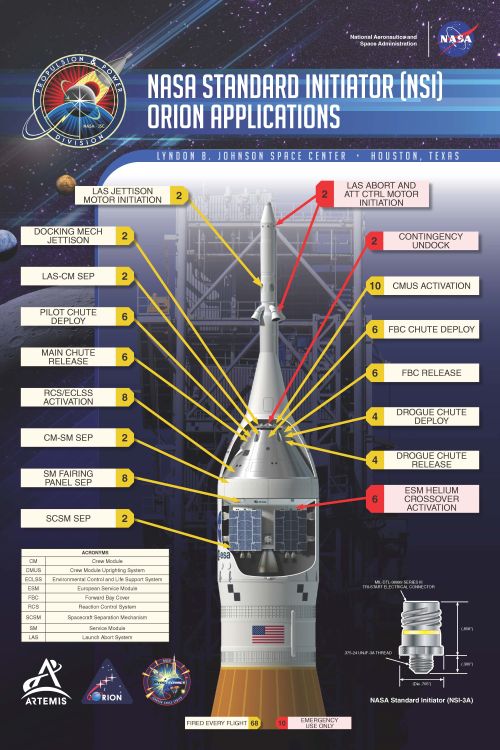
NSIs are electrically initiated pyrotechnic devices that convert a command signal into a reliable ignition event, enabling separations, releases and deployments across the spacecraft. During Artemis II, the crew travelled 252,756 miles from Earth, setting a record for the greatest distance humans have travelled in space while capturing new views of the lunar surface. Key phases of that journey, from ascent safety to splashdown recovery, are supported by NSIs. Up to 70 NSIs are fired on every flight, depending upon the configurations needed for each mission.
Key Orion functions enabled by NSIs
Launch Abort System (LAS)
The Launch Abort System (LAS) protects astronauts during ascent by pulling the crew module away from the rocket in an emergency. While Artemis II achieved a nominal ascent, the LAS remained fully armed, with NSIs allocated for:
- LAS jettison motor initiation (2 NSIs)
- Abort and altitude control motor initiation (2 NSIs) – emergency use only
- LAS–Crew Module separation (2 NSIs)
These systems remain live until the LAS is safely jettisoned shortly after launch, an operation executed through tightly controlled pyrotechnic events.
Stage and module separation
Orion relies on multiple pyrotechnic separation events, including:
- Crew Module–Service Module (CM‑SM) separation (2 NSIs)
- Spacecraft Separation Mechanism (SCSM) activation (2 NSIs)
- Service Module Fairing Panel separation (8 NSIs)
- Docking Mechanism Jettison (2 NSIs)
Parachute deployment sequence
The dramatic splashdown that marked Artemis II’s successful return was made possible by a complex, multi-stage parachute system activated by NSIs:
- Forward Bay Cover (FBC) chute deploys (6 NSIs)
- FBC release (6 NSIs)
- Drogue Chute Deploy (4 NSIs)
- Drogue Chute Release (4 NSIs)
- Pilot Chute Deploy (6 NSIs)
- Main Chute Release (6 NSIs)
Contingency and emergency capabilities
NSIs are also allocated for several vital contingency and emergency systems:
- Contingency Undock (2 NSIs) – emergency use only
- Reaction Control System / Environmental Control and Life Support System (ECLSS) activation (8 NSIs)
- Crew Uprighting System (CMUS) activation (10 NSIs)
- ESM Helium Crossover Activation (6 NSIs) – emergency use only
Artemis III and beyond
Looking ahead, Artemis III, planned for 2027, will build on the progress of Artemis II as NASA advances toward sustained lunar exploration and, ultimately, crewed missions to Mars. With 77,150 different types of parts used across Orion, proven, flight-qualified components, such as CED’s NSIs, will continue to play a vital role in executing time-critical events that support mission success.